
Gold has never been just a commodity in Asia. For generations, the yellow metal has embodied blessing, family continuity, and spiritual connection, woven into wedding dowries, Lunar New Year gifts, and the transfer of wealth across generations.
This cultural underpinning continues to shape market mechanics today. Asian demand remains deeply anchored in physical ownership, with a strong preference for high-purity 22k and 24k gold over the 14k and 18k standards more common in Western markets.
The emphasis on purity shapes everything from refining protocols and bar sizing to assay standards and custody requirements. It also explains why credible Asian gold markets have long prioritised physical delivery, 999.9-fineness bullion, and institutional-grade vaulting, which must all be in place before they can expand effectively into derivatives, structured products and digital rails.
Today, gold is a US$31 trillion global financial cornerstone. It operates within a complex, multi-layered ecosystem in which physical bars, paper contracts, exchange-traded funds and digital tokens coexist, each serving distinct risk, liquidity, and portfolio objectives.
Daily liquidity across all forms of gold trading is estimated at about 3,000 tonnes, or $361 billion, sustained by the interaction of physical, over-the-counter, ETF and token flows.
Physical gold remains the foundation. It offers zero counterparty risk, but also carries significant operational costs across storage, logistics, insurance, and assay verification.
Paper markets, by contrast, dominate trading velocity. The London Bullion Market Association (LBMA) clears approximately $1.1 trillion weekly through OTC bilateral spot and forward trades, while New York’s Commodity Exchange (COMEX) futures handle roughly 27 million ounces daily.
However, the convenience of paper contracts comes with counterparty and settlement risk. Less than 1% of paper trades ultimately result in physical delivery. The gap between high notional trading volume and low physical settlement frequency highlights the need for a strong, transparent clearing and settlement infrastructure.
Meanwhile, gold’s evolution from a physical commodity into a widely traded financial asset has accelerated dramatically through pooled and digital instruments. According to the World Gold Council (WGC), globally listed gold ETFs held over $559 billion of assets under management at the end of 2025, enabling institutions to gain liquid exposure without holding physical custody directly.
At the same time, tokenised gold products have scaled rapidly. Market capitalisation has surpassed $4 billion and trading volumes surged more than 1,550% year-on-year in 2025. These products can support 24/7 settlement, fractional ownership, and programmable custody. But they are constrained by regulatory fragmentation, as well as reliance on external price feeds rather than live market activity.
To be credible, an Asian gold hub must be able to capture value across the entire ecosystem. It cannot succeed by focusing solely on physical logistics. It must provide the post-trade plumbing, multilateral netting, and transparent audit trails required to support institutional paper flows, ETF creation and redemption, and emerging digital settlement rails simultaneously.
Demand and supply
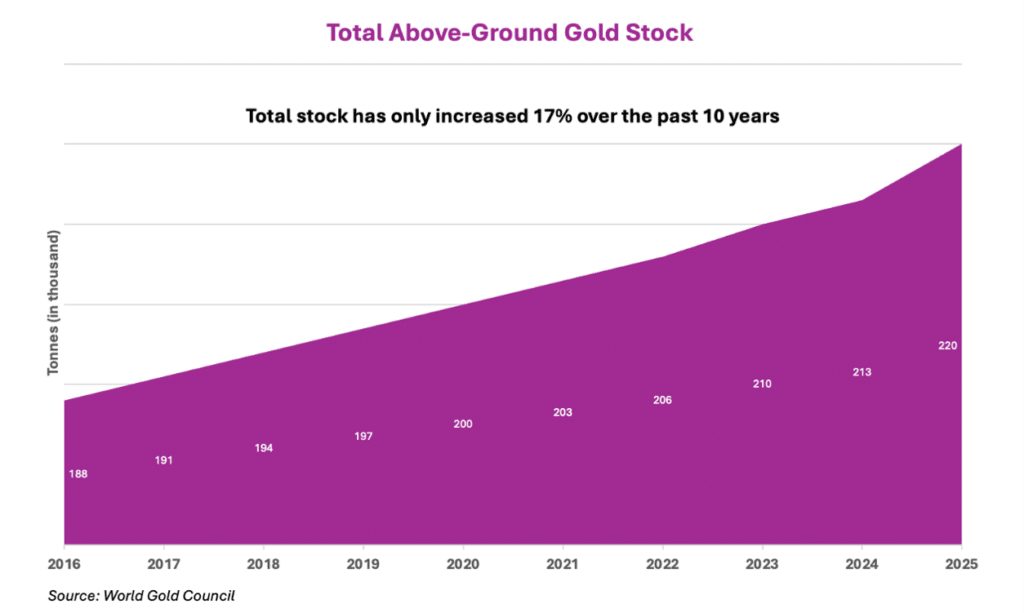
Global gold demand has been rising faster than supply. The WGC estimates that above-ground gold stock totalled about 219,891 tonnes in 2025, valued at roughly $31 trillion. The stock increased by only about 32,000 tonnes, or 17%, over ten years, highlighting the metal’s fundamental scarcity. Meanwhile, the value of gold jumped 355% over the same period, underscoring its growing role as both a monetary and strategic asset.
The structural pivot in demand is also evident in central bank buying. WGC figures show that central banks purchased 863 tonnes of gold in 2025, led by the People’s Bank of China and the Reserve Bank of India.
The Financial Times reported in June that gold had overtaken US government bonds as the world’s largest reserve asset by the end of 2025, accounting for 27% of global central bank reserve assets compared with 22% for US Treasuries. Although this was driven in part by a 60% nominal price appreciation, the underlying trend towards reducing dependence on the US dollar is clear.
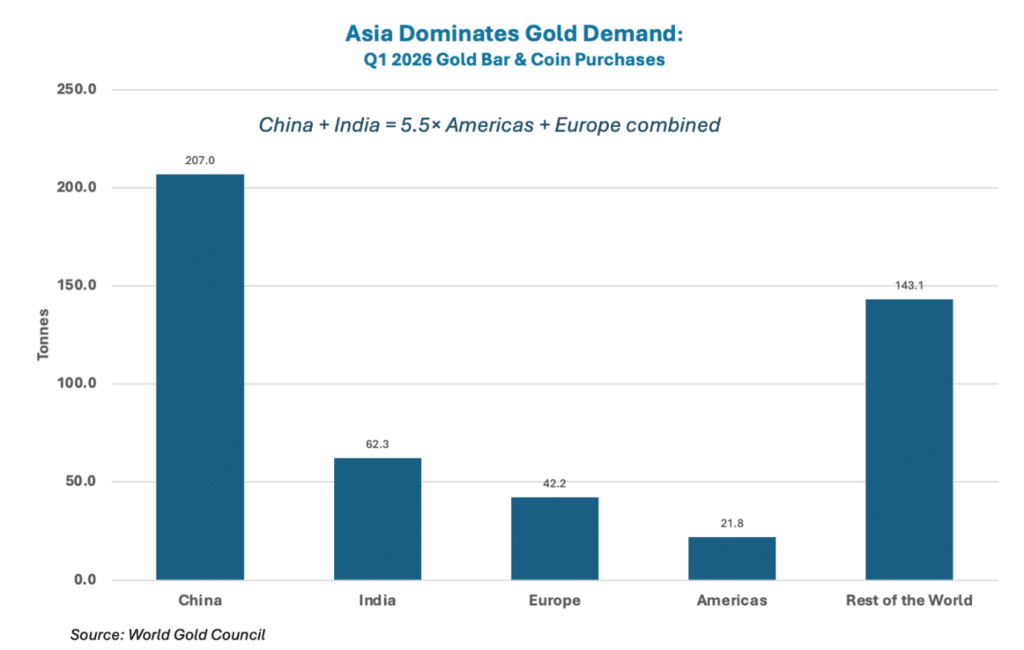
Physical investment demand followed the same trajectory. Global purchases of gold bars and coins reached 476.9 tonnes in the first quarter of 2026. China was the single largest buyer with 207 tonnes, surpassing the combined total for the Americas and Europe. And China and India together bought five-and-a-half times more than the total for the Americas and Europe.
The time zone gap
For decades, price discovery, clearing, and settlement have been concentrated in Western time zones. The LBMA sets the twice-daily gold price benchmark at 10:30 and 15:00 London time, while COMEX remains central to futures liquidity and options hedging. Together, these markets provide unmatched depth, trusted good delivery custody standards, and seamless ETF integration.
Although Asian institutions increasingly drive both physical and financial demand, roughly 70% of global gold trading volume still occurs during London and New York business hours. This creates a structural mismatch: Asian sessions face thinner liquidity, wider bid-ask spreads, and limited local reference pricing or same-day settlement infrastructure. Cross-border Asian trades often involve 24- to 48-hour counterparty windows, increasing hedging costs, margin requirements, and operational risk.
This “Asian pricing gap” leaves regional traders exposed to overnight rollover risk and often forces them to absorb premium pricing when London opens. The associated settlement risk is estimated at $2.2 trillion in daily exposure.
In an interview with the Hong Kong Economic Journal in May, Albert Cheng, chief executive officer of the Singapore Bullion Market Association, noted that gold trading, clearing, and back-office services in Asia remain centred around London. In practice, buyers and sellers often need to maintain accounts in London for settlement.
“Asia’s gold prices often carry a premium over London due to potential shipping and insurance costs after settlement. The existing trading model limits efficiency, so the development of gold trading centres in Hong Kong and Singapore is a natural result of market forces,” he said.
Physical delivery from London or Swiss refiners is also assayed and logged in local vaults and then transferred to end buyers via armoured logistics under separate insurance coverage and customs declarations. Each leg of transit adds cost and complexity, directly impacting the efficiency of Asian-session executions.
Current gold market infrastructure has not fully kept pace with the shift in demand. Market participants are seeking more efficient ways to access liquidity, manage risk, and settle transactions during Asian trading hours. The aim is not only to reduce execution costs and compress settlement cycles, but also to manage geopolitical custody risk more effectively.
Hong Kong’s response
Hong Kong has moved to address the issues with an initiative launched in 2024 that aims to capture structural shifts in Asian gold flows and absorb a meaningful share of activity currently routed through Western clearing venues.
The programme combines a government-backed central clearing system, aggressive vault capacity expansion, deeper cooperation with China, targeted tax incentives to attract gold refiners, and a regulatory sandbox to test tokenised products and clearing procedures under live market conditions.
Crucially, this is not a greenfield experiment. Hong Kong already has the foundations required for this transition: a freeport customs regime, unrestricted capital convertibility, common-law contract enforcement, and assay facilities with LBMA Good Delivery accreditation.
The Hong Kong Gold Exchange already handles substantial daily wholesale turnover, while the city’s deep commodities-finance ecosystem — including insurance, logistics, derivatives, and specialist advisory firms — provides immediate access to institutional liquidity. The real question is whether the city can convert these existing strengths into market infrastructure that attracts durable, long-term liquidity.
Asia does not lack demand, custody expertise, or capital. What it lacks is a settlement and clearing centre that matches the region’s scale, investor requirements, and time zone-alignment.
*This article, the first in a four-part series, is co-authored by Lawrence Au and Margery Wong, chair and vice-chair, respectively, of the FinEx Club Research Centre asset-servicing committee, with the support of researcher Leo Chung. The Centre, which provides insights on key financial sector issues, is a think tank of the FinEx Club, a network of senior financial executives.