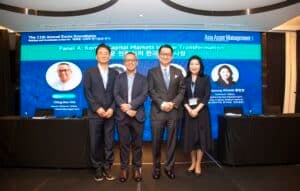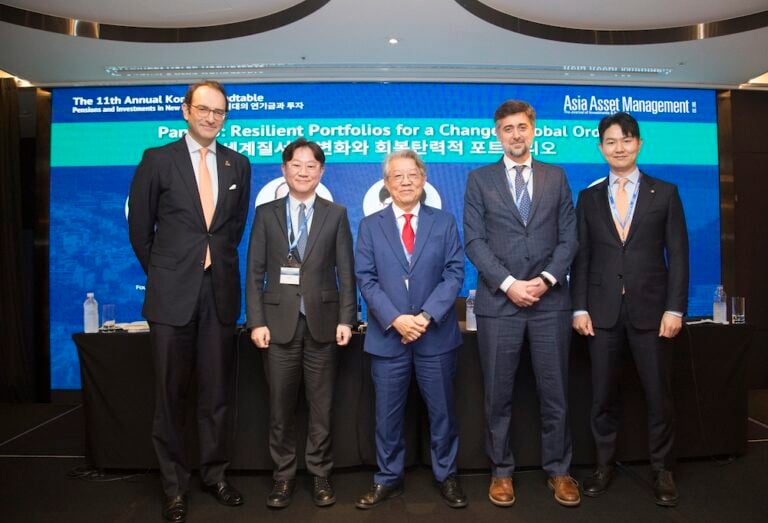

Several top asset management executives discussed emerging opportunities and looming challenges amid evolving global economic dynamics and shifting market fundamentals at Asia Asset Management’s recent investment forum in Korea.
Hoon Lee, executive vice president and chief investment officer of sovereign wealth fund Korea Investment Corporation (KIC), and one of four members of a panel session, noted that higher-than-expected US inflation and war in the Middle East have impacted share prices and triggered short-term volatility.
But he argued that US corporate fundamentals remain “solid”, with companies posting average double-digit earnings growth in the first quarter.
“We are questioning whether interest rate hikes genuinely undermine the overall economic trajectory and fundamentals,” Lee said during the panel session at the forum in Seoul on May 20. “There’s no need to adopt such a pessimistic outlook unless the Middle East crisis persists for an extended period.
According to fellow panellist Andrew Hendry, Asia chief executive officer, senior managing director, and head of Asia client group at UK investment firm Janus Henderson Investors, global markets are being driven by a substantial amount of “momentum money”, which tends to follow the herd and makes it challenging to generate sustainable profits.
Although US technology giants like NVIDIA Corporation have been at the forefront of investor interest, he said the outlook for global markets remain “exciting” across various industries from a fundamental earnings perspective.
“We’re seeing incredibly attractive opportunities emerging in emerging markets and even in Europe, particularly in areas such as defence and technology,” he said.
The third panellist, Doug Young Cha, head of the retirement pension business division at Korea’s Hanwha Asset Management, observed that ageing demographics have gone beyond being a social issue to become an investment challenge.
“Over the past two decades, global investors benefitted from globalisation, low inflation and abundant liquidity,” he said. “However, we’re now entering a fundamentally different regime characterised by geopolitical fragmentation and higher government deficits. This shift means that market volatility is becoming more structural rather than temporary.”
He said the greatest challenge for investors is how to sustain retirement outcomes amid these volatile market conditions.
He is also concerned about the risk of investment portfolios becoming overly concentrated in a small number of sectors, particularly artificial intelligence and semiconductors.
The fourth panellist, Tommaso Mancuso, president and chief investment officer at Canadian digital asset investment firm 3iQ Corp, flagged how bear markets historically tend to occur roughly every five to seven years.
“While the current AI-driven market rally suggests that the market is in strong shape and could potentially extend beyond expectations, I remain cautious and suspect that increased volatility is on the horizon,” he said.