
Hong Kong is moving beyond its role as Asia’s main physical gold pass-through corridor. Two years ago, the city announced a gold hub initiative that aims to capture more value upstream by turning from a transit stop into a clearing node for institutional players.
John Lee, Hong Kong’s chief executive, called it an “economic game changer”. The goal is to bring pricing power and risk management capabilities from London and New York into Hong Kong’s orbit.
For decades, Hong Kong has served as Asia’s primary physical gold gateway, supported by a longstanding trade and settlement ecosystem: a freeport customs regime, open capital convertibility, and a mature banking sector.
At the centre of this ecosystem is the Hong Kong Gold Exchange (HKGX), formally established in December 2024. Building on a legacy institution with more than a century of history, the exchange continues to operate as the region’s main physical spot venue. It has 137 member institutions, including banks, leading jewellery retailers, gold refineries, and financial institutions.
Trading activity on the HKGX is significant: average daily turnover of its flagship 99 Tael Gold product exceeds HK$2.9 billion (US$369.8 million).
Hong Kong also supports substantial wholesale volumes. Daily over-the-counter activity, used by international dealers and institutional participants, is estimated to be at least five times that of the HKGX.
Credibility is also well established. Hong Kong’s assay facilities hold LBMA Good Delivery accreditation, a global benchmark that signals readiness for institutional settlement and custody.
Shaokai Fan, head of Asia Pacific and global head of central banks at the World Gold Council, said recently that certification functions like an “international passport” for precious metals, making gold cleared and stored in Hong Kong readily acceptable to institutional buyers in Europe and North America.
Custody and contract infrastructure are also in place. The Precious Metals Depository at the Hong Kong International Airport (HKIA) has long provided a baseline framework used by international banks.
Meanwhile, Hong Kong’s legal environment — common law contract enforcement and independent dispute resolution — combined with deep liquidity in trade finance, provides the operating conditions required for a trusted precious metals node.
Three key priorities
Despite such scale, Hong Kong faces a structural bottleneck: it lacks retained liquidity. Gold typically flows through the city as a transit good — imported, processed and refined, and then re-exported to China or other Asian markets. This supports trade finance but doesn’t automatically create the two-way order books needed for robust price discovery and sophisticated hedging.
In practice, without retained market participation and centralised settlement, Hong Kong remains closer to a corridor than a true financial node for gold trades. That limits its ability to capture the full value beyond custody and bilateral trading.
Instead of focusing primarily on physical movement, Hong Kong is building the market infrastructure that allows institutions to hold, trade, and hedge gold positions within the Asian time zone.
This includes central clearing, multilateral netting, and same-day finality, all of which reduce settlement latency and lessen the need for Asian investors to anchor benchmark activity in London.
The goal is to move Hong Kong from a passive corridor to an institutional clearing and custody platform, capturing recurring fee income while improving the efficiency of how gold positions are settled and managed.
The blueprint is sequenced and interconnected, with three core priorities: scaling physical infrastructure, building central clearing, and expanding product access.
- Infrastructure
Hong Kong is developing physical infrastructure capable of supporting institutional-scale refining and storage requirements.
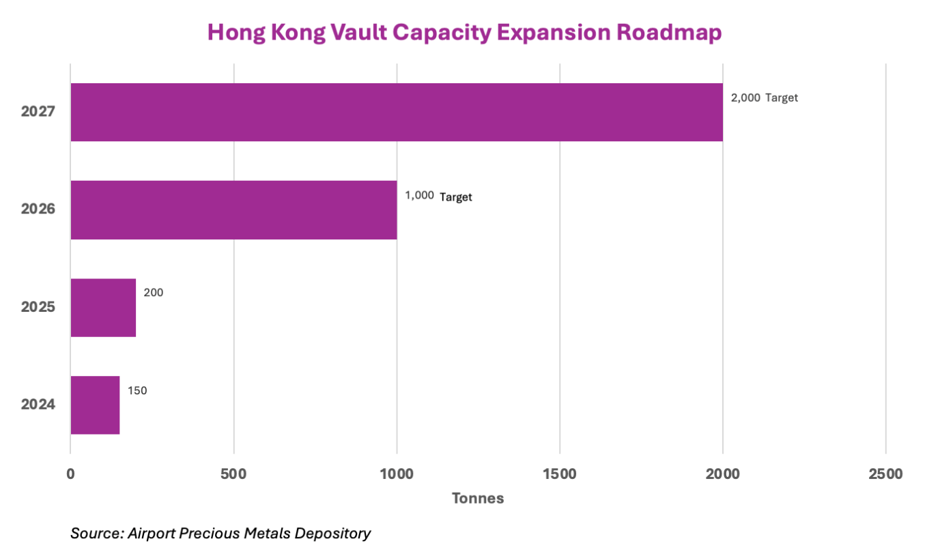
The HKIA Precious Metals Depository has already increased vaulting capacity from 150 to 200 tonnes, with a roadmap targeting 1,000 tonnes initially and more than 2,000 tonnes within three years, more than ten times the 2024 baseline. The model leverages the city’s existing customs infrastructure to reduce inefficiencies for firms importing, storing, and re-exporting bullion.
These vaulting facilities also address the need for physical gold delivery from London or Swiss refiners to settle transactions executed in the Asian time zone, reducing cost and complexity.
In parallel, the government is offering tax incentives and streamlined licensing to attract LBMA-accredited refiners to Hong Kong. This addresses a persistent issue: gold mined or processed in the region is often routed to Swiss refineries before being shipped back to Asia for end use.
Agreements have also been signed with Shenzhen to process imported gold through Mainland facilities before returning it to Hong Kong for storage and institutional access.
The Shanghai Gold Exchange opened its first offshore physical gold delivery vault in Hong Kong in June last year. This creates a direct institutional link between China’s domestic gold demand and Hong Kong’s international platform, allowing Chinese refiners and institutional buyers to access LBMA-aligned custody within the city’s jurisdiction.
- Clearing system
The centrepiece of Hong Kong’s gold hub initiative is the gold central clearing and settlement system, owned by the government’s Hong Kong Precious Metals Central Clearing Co Ltd.
The platform, which began trial operations on July 7, is modelled on London’s bullion market infrastructure. It will support over-the-counter spot gold settlement through unallocated accounts, enabling faster and more scalable trading without requiring specific numbered bars to be assigned to every transaction.
Just as importantly, the system is designed to act as a central counterparty, reducing bilateral credit risk and supporting same-day final settlement. It also accommodates renminbi-denominated transactions, addressing settlement latency and currency friction that can raise costs for Asian participants.
- Widening product access
Hong Kong already has established physical gold exchange-traded funds such as the SPDR Gold Shares and Value Gold ETF. This year, the Hang Seng Gold ETF and CSOP Gold ETF were launched, offering flexible cash or physical creation and redemption options.
Two years ago, HSBC launched the HSBC Gold Token for retail investors. It has since surpassed $1 billion in trading volume, becoming Asia’s largest tokenised commodity product.
In April this year, HSBC and Hang Seng Investment launched Hong Kong’s first tokenised unlisted share class of a gold ETF on the HashKey Exchange. A month later, China Asset Management Company listed a tokenised gold ETF on the Hong Kong Exchanges and Clearing (HKEX).
The HKEX also plans to launch a US dollar gold futures contract with a one-kilogramme physical delivery size. Deliberately smaller than the New York Commodity Exchange’s 100-troy-ounce standard, the contract is designed to lower capital barriers for regional participants while remaining interoperable with global market structures.
At the same time, HKGX is developing a blockchain-enabled transaction traceability mechanism aligned with LBMA Responsible Gold Guidance.
The Hong Kong Monetary Authority’s tokenisation pilot, which was also launched on June 7, is testing gold settlement on the Hong Kong dollar real-time gross settlement system.
Upgrade, not replacement
The gold hub initiative is not a clean-slate replacement of Hong Kong’s gold ecosystem. It is an upgrade that positions existing strengths for a new role.
The shift from a physical trading gateway towards a comprehensive financial clearing node is a natural next step for a jurisdiction that has long served as Asia’s gold nexus, but has not yet fully captured the value chain beyond custody and bilateral trading.
In a report in June, KPMG pointed out that Hong Kong has both the ambition and the attributes to fill the gap, with the building blocks already being laid. “A complete gold value chain in one jurisdiction is Hong Kong’s prize to claim,” according to the report.
But infrastructure alone will not guarantee liquidity. The clearing system must demonstrate resilience under stress. Anchor participants must commit balance-sheet capacity early. Cross-border settlement must manage China’s capital controls without creating compliance friction that discourages participation.
*This article, the second of a four-part series, is co-authored by Lawrence Au and Margery Wong, chair and vice-chair, respectively, of the FinEx Club Research Centre asset-servicing committee, with the support of researcher Leo Chung. The Centre, which provides insights on key financial sector issues, is a think tank of the FinEx Club, a network of senior financial executives.